#141 How To Design A Membership People Never Want To Cancel
Go deeper on this week’s Build With Becky podcast:
Lately, I’ve been spending a lot of time inside other people’s memberships as a strategist who is paid to look closely at what is actually working and what is quietly breaking down behind the scenes.
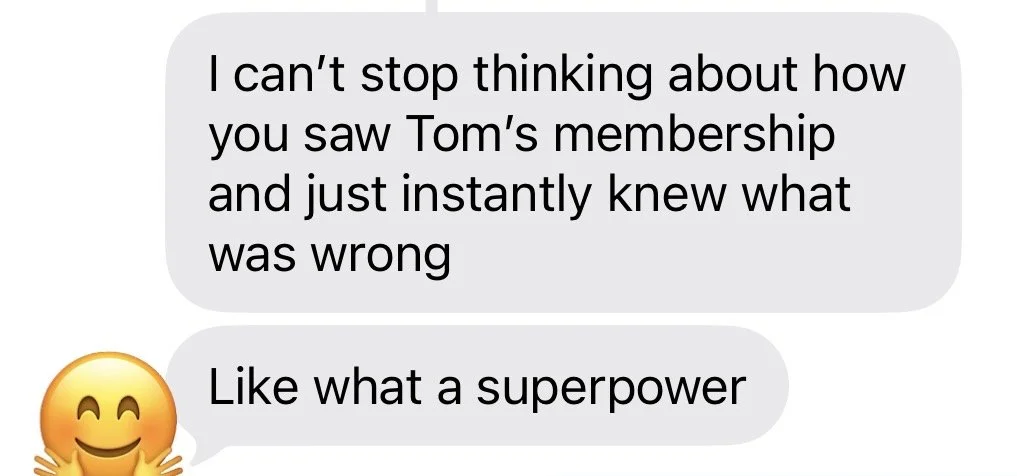
A text I got this week from someone who hired us to do a membership strategy for her client
At Affinity, we’re running two to three membership strategy intensives every single week, supporting community builders who are either launching something new or trying to stabilize a membership that used to feel solid but now feels harder to grow, retain members, and harder to explain why it should exist in its current form.
Across all of those conversations, I keep noticing the same thing.
The memberships that are thriving right now are not the ones with the most content, the most calls, or the most complicated tech stacks. They are the ones that feel sticky in a very specific way, where logging in becomes part of someone’s normal rhythm and participation feels natural instead of forced.
That stickiness is not accidental. It is designed.
Let's get into it –
When I talk about a sticky membership, I am talking about an experience that earns repeat engagement because members genuinely feel supported, and confident that staying involved is helping them move forward. They've built a habit of logging in.
These are the members who come back without reminders, who build relationships inside the space, who make progress that they can see and feel, and who rarely reach the point where cancellation feels like an obvious or easy decision.
Sticky memberships create raving fans, steady referrals, and sustainable retention without relying on constant urgency, heavy discounts, or perpetual relaunch cycles.
And almost every sticky membership I’ve seen recently has the same three components.
01 Personalization From Day One
If you want members to feel like your membership was built specifically for them, you have to demonstrate that immediately, not three months in after they have already decided whether they belong.
Most memberships still rely on a single onboarding experience that introduces everyone to the same content in the same order, regardless of where they are starting or what they actually need most right now.
That approach makes it much harder for a new member to feel confident, grounded, and clear on what their next best step should be.
Think about how your favorite streaming platform works. When you log in, the experience reflects your preferences, your behavior, and your history, which subtly reinforces the feeling that this space understands you and is worth returning to.
But personalization inside a membership does not require sophisticated technology. It can look like offering different paths based on goals, creating tier-specific experiences, recommending a starting point instead of a full library, or offering a welcome call that helps members orient themselves quickly.
The goal is to reduce friction early and replace it with clarity, relevance, and a sense of belonging that begins before community interaction ever comes into play.
02 Speed Up Time To Value
The second ingredient of a sticky membership is speed – specifically how quickly a member can experience a meaningful win that reinforces their decision to join.
This matters more than ever because expectations have changed. AI and automation have dramatically shortened the distance between problem and solution, and people are no longer willing to wade through dozens of hours of content before they see tangible progress.
When I work with clients on this, we start by clearly defining the transformation they are promising, and then we design the membership backwards from that outcome, focusing on the fastest possible path that helps someone move from where they are to where they want to be.
Instead of building a content-heavy experience that tries to cover every possible scenario, sticky memberships prioritize tools, templates, prompts, workflows, and micro-experiences that accelerate momentum and help members feel capable almost immediately.
This does not shorten the member lifecycle in a negative way. When people make progress quickly, they develop trust, and that trust is what keeps them engaged as new challenges emerge and their goals evolve.
03 Build Intentional Human Connection
The final component, and the one that will matter most in 2026 and beyond, is human connection that is thoughtfully designed rather than left to chance.
As education becomes easier to replicate and tools become faster to build, connection is what differentiates your product. A membership that feels relational, welcoming, and alive is far harder to replace than one that simply delivers information.
But connection does not automatically happen because a community space exists (*shouts into the void!!!*)
It is shaped by culture, modeling, and systems.
Members take cues from what they see, including how conversations are started, how newcomers are welcomed, and how visible it is to participate without feeling awkward or out of place. Community builders are natural connectors, often making introductions instinctively and spotting overlaps between members without even realizing they are doing it.
The opportunity is to move that magic out of your head and into your processes.
One of the most useful prompts I’ve been given recently from my agency business coach was to identify the things I do that make working together feel special, and then ask how those behaviors could become part of the system instead of something only I can deliver.
When connection is embedded into your onboarding, your programming, and your internal rhythms, it becomes scalable, consistent, and deeply sticky.
Why This Matters Now
There is a lot community builders can learn from modern software companies that have invested heavily in experience, identity, and belonging alongside their core product.
Take Kit, which on paper is “just” an email platform, but in practice feels much harder to replace because of the ecosystem they’ve built around it. They invest heavily in creator connection through their creator meet-ups, Craft + Commerce conference, recording studios, and the Creator Network where creators can discover and recommend one another.
That layer of human connection makes the product feel alive, and it dramatically raises the emotional cost of leaving, even when other tools might offer similar features.
As education becomes more accessible and apps become easier to spin up, memberships that combine personalization, fast progress, and intentional human connection will stand out in a crowded market.
That combination is difficult to replicate, which is exactly why it works.
Action Steps
If you want to assess how sticky your membership really is, start here:
Identify the first meaningful outcome a new member should experience within their first week and design toward that moment.
Review your onboarding experience noticing where personalization could replace overwhelm.
Write down the connection behaviors you personally use to make members feel seen and choose one to formalize.
Audit your content and remove anything that slows momentum rather than supporting progress.
Stickiness is not created by doing more. It is created by designing with intention.
It's Happening...
This shift is already happening, whether or not we consciously respond to it.
Memberships that evolve toward clarity, connection, and momentum will continue to grow, while those that rely on volume and complexity will find retention increasingly difficult.
If you want support thinking through how this applies to your own membership or program, I’m hosting a live training this week where we’ll go deeper into how to future-proof your model and design for the way people actually want to engage now. I’d love to have you join us.
Future-Proof Your Membership
Learn the exact framework we’re using in 2026 with 6 + 7-figure brands to improve membership engagement, retention, and growth + future-proof your membership so it doesn’t become obsolete in the age of AI.