#143 Play The Long Game To Win
I'm sitting on my couch writing to you while I'm watching the Winter Olympics. I am always so blown away and inspired by Olympic athletes.
When I think about entrepreneurial delusion – the belief in oneself to do what most would consider impossible – I think about Olympic athletes.
It's this desire to be the best in the world at what you do. And I respect the hell out of that.
I went to college in NYC and I always used to love the saying that "everyone in NYC wants to be the best at what they do". I have always loved surrounding myself with people that are dedicated to their craft / art / mission / purpose, etc.
While I was working on updating our positioning and messaging for Affinity, I made a list of qualities that our best and most successful clients shared (sidebar – highly recco this exercise)... and on that list:
Our most successful clients strive to have the best products on the market.
Let's talk about what that means –
The most successful products on the market serve their clients well and have incredible results. They have 5 star reviews, strong word-of-mouth growth, impressive case studies and testimonials.
If that sounds like what you're working toward... keep reading.
Business owners stress so much about marketing – where is my next sale coming from, which marketing channel should I try next, etc. The truth is marketing is so much easier when you have a great product.
But most people don't realize how long it takes to build a great product.
Just like an olympic sport, you have to practice, experiment, test, and measure results just to make minor adjustments that get you 0.01 closer to gold than your last rep.
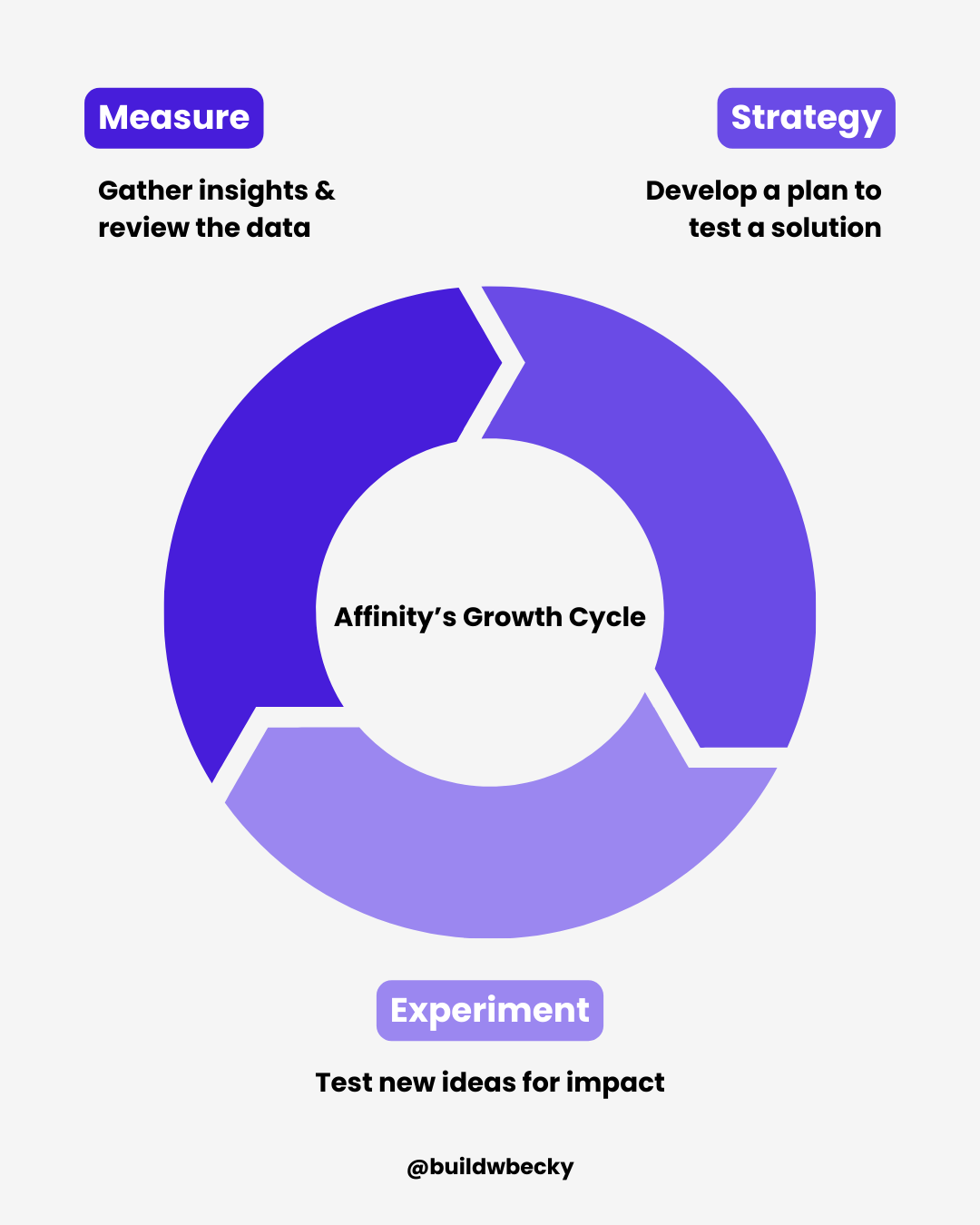
This is our approach to growth at Affinity. We look for every tiny gap that exists, minor improvements we can make, and experiments we can run.
Not only will this have an impact on customer success, engagement, and building the best product in your niche... but it also has huge revenue impacts. Let me show you with simple math:
Let's say you have 300 members paying $150/mo with 15% churn (so your retention rate is 85%)
If you increase your retention rate to 90%, your revenue goes from $38,250/mo to $40,500/mo.
That’s an extra $2,250 every single month — without selling a single new membership.
And this easy math doesn't even include the compounding effects of new members coming in each month.
So what does “playing the long game” actually look like in practice?
It’s not about overhauling everything overnight. It’s about designing for progress and chasing 1% better every week.
Here’s where I’d start:
Measure – Choose one area of your membership to improve. For example, if you're struggling with engagement and show-up rates to your events, narrow in on your programming.
Strategy – Based on what the data tells you, identify the bucket that is leaking the most. Decide which moment in the journey matters most right now and design solutions to test fixing it.
Experiment – Design one small test meant to plug that bucket. It might be a clearer expectation, different event types, or designing for more connection.
The businesses that win aren’t always the loudest or the fastest. They’re the ones willing to stay in the work long enough to earn trust, results, and momentum that compounds.
If you want help finding the gaps, designing smarter experiments, or building a product that actually gets better every month, that’s the work we do at Affinity Collective.
Gold medals aren’t won in a single season & neither are great products.
Go deeper on this week’s podcast:
Education has never been easier to access. Answers are instant and content is everywhere... but people feel more isolated than ever.
In this episode, I unpack why that tension is exactly why 2026 is one of the best years to be building community. As AI and technology continue to flatten access to information, the real differentiator for businesses is no longer content or education. It’s connection, belonging, and shared experience.